
Which electric guitar strings should you choose?
Choosing electric guitar strings comes down to three things: gauge, winding type, and how you actually play. For standard tuning and lead playing, a light set — 09-42 or 10-46 — is usually the easiest choice: strings bend more freely and put less strain on your wrist. If you're playing riffs in lower registers or dropping your tuning, a hybrid set like 10-52 Light Top/Heavy Bottom, or a full heavy 11-56, holds up better. On the winding side, classic nickel-wound strings (like D'Addario XL) give you a warmer, more "alive" tone from day one, while coated strings (like D'Addario XS) sound nearly identical but stay fresh much longer — a solid choice if you play often or gig regularly. There's no single "best" set — only the set that matches your guitar and your playing style.
String gauge: the first decision, not the last
String gauge affects more than people expect — tension, playing comfort, even how your amp responds. Lighter strings, like 08-38 or 09-42, bend under less pressure, which makes solos, vibrato, and fast runs easier — a common choice for blues and rock players who "sing" through the guitar. The trade-off is that at lower tension a string has less material vibrating, so tone can feel a touch thinner, and on shorter-scale guitars (24.75", like Les Paul-style models) that tension difference compared to Fender's longer 25.5" scale is even more noticeable.
On the other hand, if you play a lot of low-register riffs, drop your tuning (Drop D, Drop C), or simply prefer a denser, fuller tone, a 10-52 (Light Top/Heavy Bottom) or 11-56 set gives you a thicker tone and less fret buzz under harder playing. It's a trade-off every player who's gone from light to heavy strings recognizes: the first few sessions, your fingers protest — but the tone, especially with distortion, gains real density.
Nickel-wound vs. coated: same tone, different lifespan
This isn't a choice between "better" and "worse" tone — it's a choice between two philosophies of string maintenance. Classic nickel-wound strings, like D'Addario XL, have been the industry standard for decades — a warm, dynamic tone that most guitarists instantly recognize as "electric guitar sound." Their downside is that sweat, dust, and oxidation do their work: after a few weeks of heavy playing, a string loses its brightness and starts sounding dull.
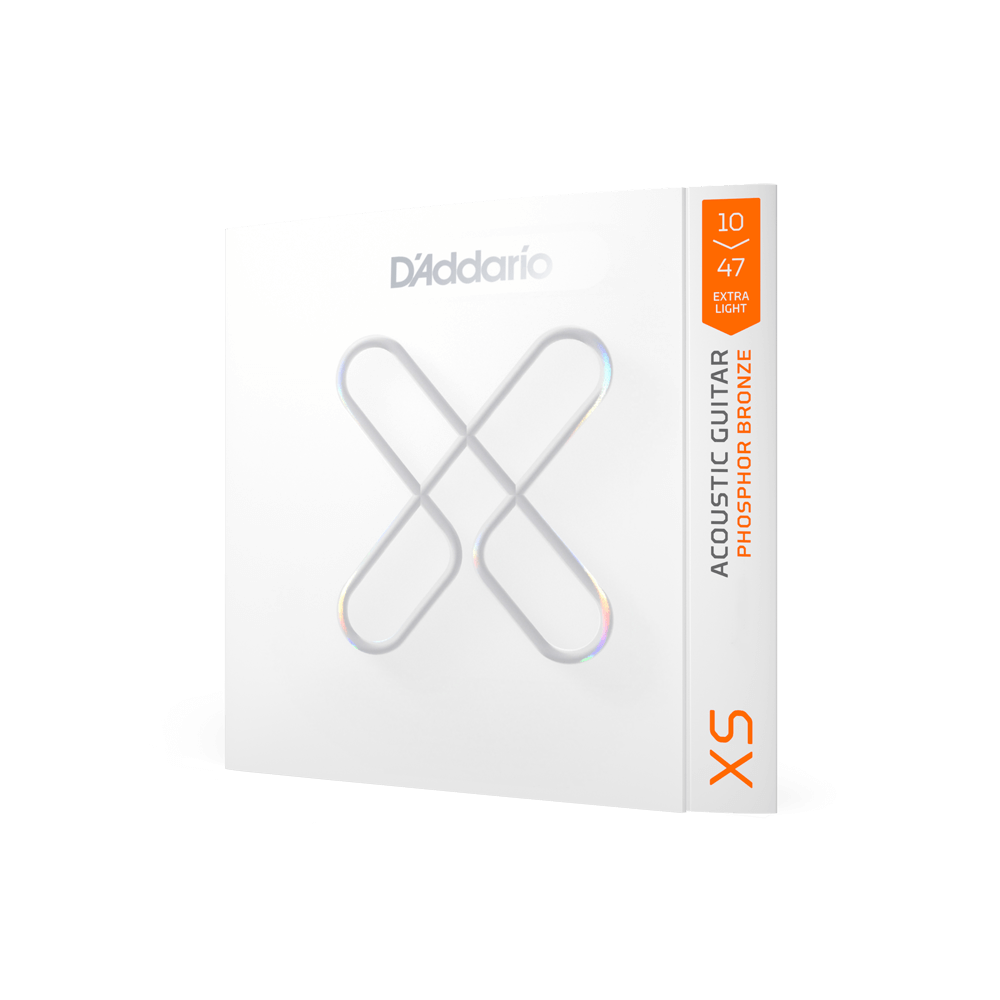
Coated strings, like the D'Addario XS line, solve that with a thin protective layer over the winding — tone barely changes, but the string stays fresh far longer. That's especially worth it if you gig regularly, sweat doesn't do you any favors, or you simply don't want to change strings every two weeks. The price difference is small next to the time and money saved from fewer string changes.
Matching strings to your guitar and playing style
Not every guitar "wants" the same strings. A shorter scale (Les Paul, SG) naturally feels looser under your fingers at the same string gauge than Fender's longer scale — which is why players on Les Paul-style or SG-style guitars sometimes reach for a slightly heavier set, to get back the tension a Stratocaster or Telecaster gives them for free.
Playing style matters just as much as the guitar itself. Blues and rock with lots of bending and vibrato — 09-42 or 10-46 is a safe, universal choice. Riffing, heavier tones, dropped tunings — 10-52 hybrid or 11-56 in standard tuning. If you're not sure, 10-46 (D'Addario EXL110) is the reference point it's easiest to experiment up or down from.
Our recommended sets
At String Taste, our entire electric guitar string range is D'Addario — across two lines that cover most needs:
- Light playing, solos, standard tuning: D'Addario XL 09-42 (EXL120) or XL 09-46 (EXL125)
- Universal choice, a good starting point: D'Addario XL 10-46 (EXL110)
- Riffing and heavier tone without changing tuning: D'Addario XL 10-52 Light Top/Heavy Bottom (EXL140)
- Dropped tunings, metal, thicker tone: D'Addario XL 11-52 (EXL116) or coated XS 11-56 (XSE1156)
- Frequent gigging, longer string life: the full D'Addario XS line in your preferred gauge, e.g. XS 9-42 (XSE0942), XS 10-46 (XSE1046) — same tone, fewer changes
Multi-packs (3-Pack) are also available in the most popular gauges, like the XL 09-42 3-Pack or XS 10-46 3-Pack — a sensible option if you play regularly and already know what you need.
Browse the full range in our electric guitar strings collection. Not sure which gauge suits your guitar? Visit us in Kraków's Kazimierz district — we'll help you find the right strings in person, over a coffee.
Share:
PRS Tremonti Review - Best Versatile Rock Guitar